
AI’s Shadow

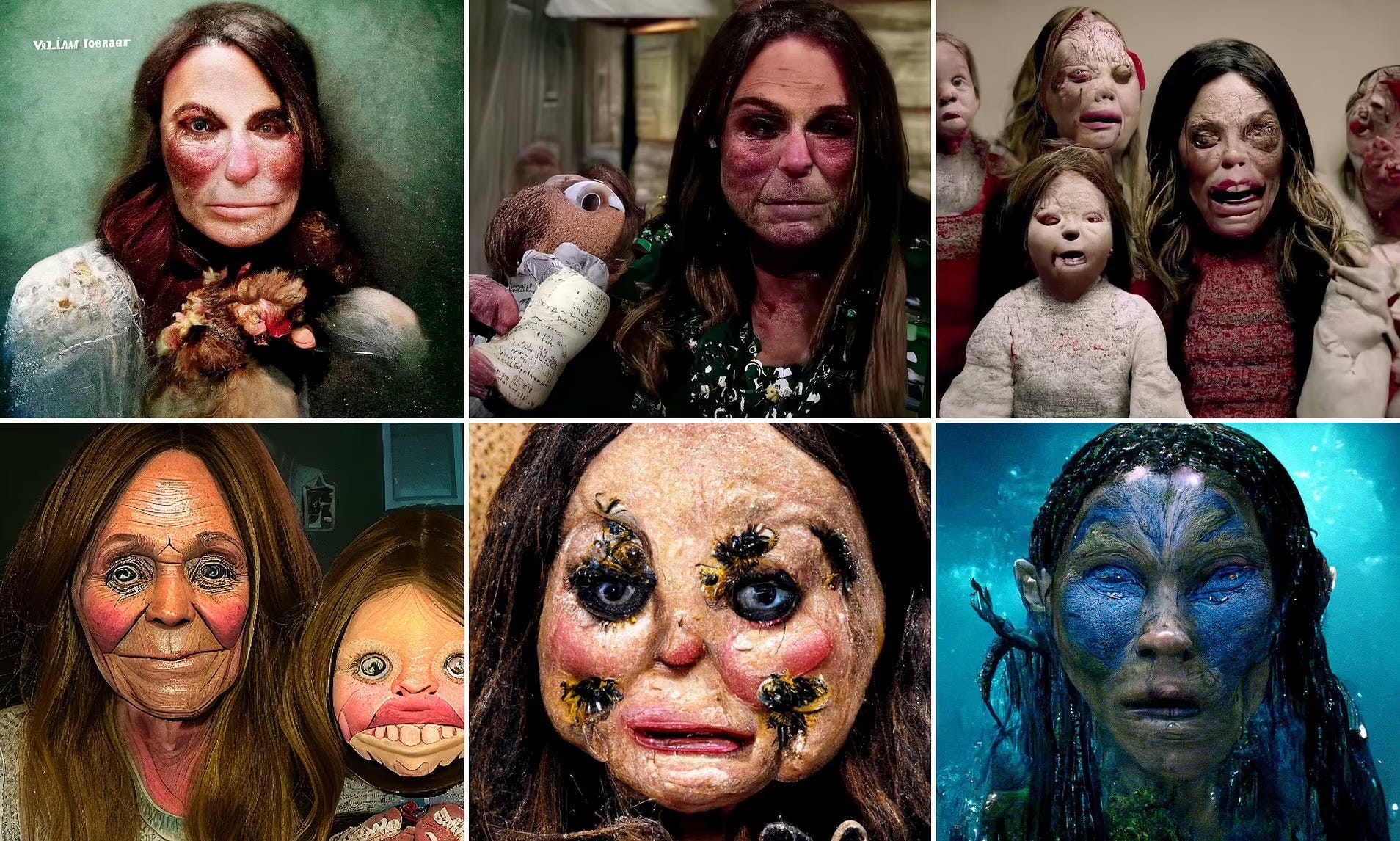
In 2022, a fascinating phenomenon emerged from the world of AI-generated art: a haunting digital figure known as Loab. Her existence wasn’t intentional. She was discovered by accident through an obscure technique called negative prompt weighting, used in image-generating algorithms.
The creator, a digital artist who goes by Supercomposite, was experimenting with this technique when Loab first surfaced from the depths of AI’s latent space.
Negative prompts instruct the AI to generate an image that is conceptually opposite to a given phrase. In this case, Supercomposite input the word “Brando,” likely referencing the actor Marlon Brando, but told AI to produce something as far removed from that concept as possible.
The result was bizarre: a surreal logo bearing the nonsensical phrase “DIGITAL PNTICS,” accompanied by an eerie, abstract design. Intrigued, Supercomposite reversed the process. They used the strange logo as a new prompt and asked the AI once again to generate something unrelated to it.
What emerged was unnerving.
The AI produced an image of a ghostly pale-faced, hollow-eyed woman, with a distorted expression that radiated sorrow and decay. She felt like a glitch in the machine, and yet, she wouldn’t disappear.
This woman, later named Loab, began to reappear across multiple generations of images, even when her likeness was combined with entirely unrelated prompts. Her features persisted: the sunken eyes, the vacant gaze, the uncanny sorrow. It was as if she had carved out a space for herself in the AI’s subconscious.
Loab’s persistence gave her an almost mythological aura, an archetype not built by design but by algorithmic emergence. She became something of a digital shadow self, a symbol of the repressed, the unspoken, and the inexplicable.
Back to Jungian psychology, with the shadow representing the parts of ourselves we deny, suppress, or fail to integrate, Loab seems to embody this principle not in a human mind, but within artificial intelligence itself. She’s not a reflection of machine consciousness but of human fears, patterns, and cultural archetypes we’ve encoded into these systems.
If the human unconscious harbors buried desires, traumas, and fears, then perhaps AI’s outputs, particularly those we don’t fully control or anticipate, mirror a collective digital unconscious.
Loab isn’t just an eerie anomaly. She could be a manifestation of our most profound uncertainties about the technology we’re creating. Her appearance asks a chilling question: What happens when the machines we build begin to reflect the parts of ourselves we least want to confront?
When we stare into the mystery of artificial intelligence, Loab stares back. And what we see in her is not the void but the haunting shape of our own shadow.
Spiritual forces simply remain human, whatever that still means. It takes more to resist the erosion, more to remember who we are, and more to hold onto the last fragments of something that once felt whole.